Identify the nest and assess access
Photos of the nest and surroundings, taken from a safe distance, help with initial identification. Handling is assessed on site. Inspection is HK$350, fully credited when treatment is booked.
WASPS
Wasp nest removal is quoted by height, access, nest size and location; there is no flat starting price. An inspection costs HK$350, fully credited when you book treatment. A photo taken from a safe distance and sent by WhatsApp can help us give an initial estimate.
Found a nest or a steady stream of wasps? Keep your distance and send us a photo for an initial assessment. An on-site inspection is HK$350, fully credited when you book; we then quote for the height, location and species. For who needs to arrange removal (FEHD or privately), see our wasp nest removal guide.
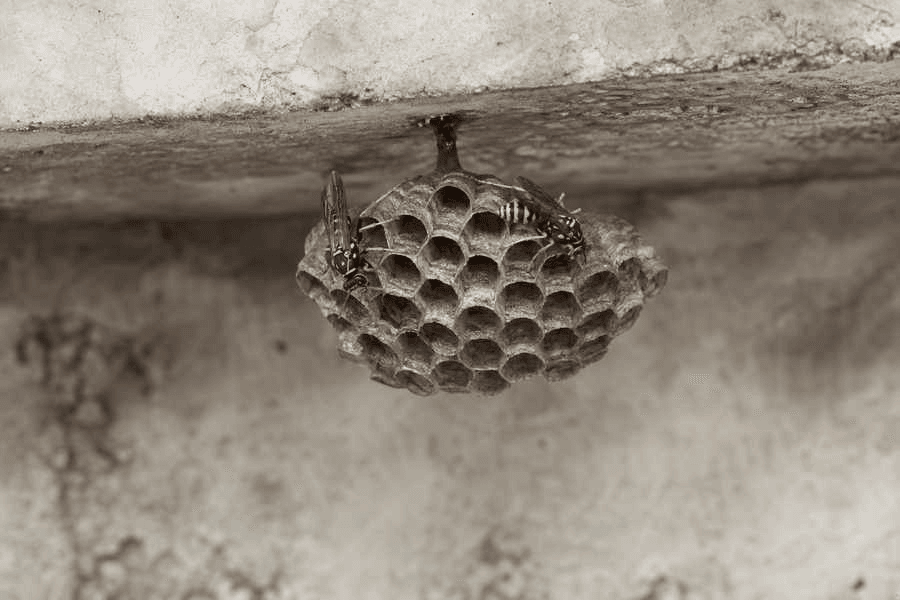
Species and nest location determine whether treatment is needed and which approach is suitable. Do not approach or remove a nest yourself. Seek emergency medical help for a severe reaction after a sting. Hornets (Vespa) commonly build paper-shelled nests, while paper wasps (Polistes) often have exposed combs; the comparison below is an initial guide.
| Type | Appearance | Nest style | Aggression | How we handle it |
|---|---|---|---|---|
| Wasps/hornets (Vespidae) | Slimmer body, yellow-black or brown-black banding, no obvious fuzz | Grey-brown paper nest, hexagonal cells inside, can range from fist-sized to basketball-sized | High — a disturbed colony attacks as a group and can sting repeatedly | Needs professional assessment and treatment, don't attempt removal yourself |
| Bees (Apis, e.g. the Asian honeybee common in Hong Kong) | Rounder body, golden-brown, visibly fuzzy | Usually nests in an enclosed cavity (a wall void, hollow tree), with neat hexagonal comb | Low — a worker dies after a single sting and rarely attacks unprovoked | Pollinators; identify first and assess whether intervention is needed |
| Mud daubers (Sphecidae) | Slender body, dark with a slight metallic sheen | Small tube-shaped mud nest, usually a single tube, doesn't form a large colony | Low — solitary, doesn't attack as a group | Generally doesn't need treatment — not a pest problem |
These are general characteristics, not a substitute for on-site identification. Photos are for initial assessment only; do not approach a nest to take one.
Photos of the nest and surroundings, taken from a safe distance, help with initial identification. Handling is assessed on site. Inspection is HK$350, fully credited when treatment is booked.
Professional removal is generally scheduled for after dusk, once the colony has returned to the nest, reducing the risk of stray wasps attacking from outside.
Confirm the approach for the species, location and risks, using appropriate protective equipment. If the nest is not a wasp or hornet nest, we first clarify whether it falls within our service scope.
We remove the remaining nest material and advise on whatever made the spot attractive for nesting, to reduce the odds of a new nest going up in the same place.
Wasp nest removal is quoted by height, access, nest size and location; there is no flat starting price. An inspection costs HK$350, fully credited when you book treatment. A photo taken from a safe distance and sent by WhatsApp can help us give an initial estimate.
Most flying stinging insects around Hong Kong homes fall into three groups. Wasp…
For nests in public places such as streets and parks, the Food and Environmental…
As of July 2026, typical market ranges for home pest control in Hong Kong: cockr…
Not necessarily. A couple of stragglers might just be foraging nearby and don't necessarily mean there's a nest close by. If you're seeing a fixed entry point, an actual visible nest, or a cluster of wasps in the same spot for several days running, that's the sign worth acting on. If you're not sure, send us a photo on WhatsApp and we'll help you work out whether it needs treating.
No. Species, nest location and the chance of contact all affect the approach. Visual comparisons are only an initial guide; the method and service scope need assessment. Do not approach a nest to confirm its species.
Nests can be larger in late summer and autumn, but the month alone does not determine risk. Species, location, nearby activity and access all affect the approach. Keep your distance and ask whether a professional assessment is needed.
The two groups you're most likely to meet in the city and the hills are: hornets (the genus Vespa — locally the lesser banded hornet is among the more common), which build grey-brown paper-shelled nests hanging from trees, eaves or external walls; and paper wasps (the genus Polistes), smaller wasps whose nests have no outer shell, with the hexagonal cells exposed — typically under window ledges, canopies and the underside of air-conditioning units. Both will defend their nest, so we don't recommend dealing with either yourself; a photo over WhatsApp is enough for an initial call on which group it is.
A wasp or hornet nest usually has a grey-brown papery outer shell — the whole thing looks like an upside-down ball or teardrop with one or two entry holes. A paper wasp nest has no shell: you see a single exposed slab of hexagonal cells. Bees rarely build anything like this in the open — they mostly pick an enclosed cavity (a wall void or hollow tree) and build neat wax comb inside. As a rule of thumb: a papery shelled nest in the open is most likely wasps or hornets; exposed wax comb in a cavity points to bees.
A straightforward nest can generally be treated in one visit, with treatment and clean-up taking around one to two hours. Height, access and site conditions can change that estimate. Other colonies may later build a new nest nearby; we explain factors such as shelter and food sources that can be addressed.