The short answer
For nests in public places such as streets and parks, the Food and Environmental Hygiene Department (FEHD) provides a wasp removal service. Residential premises with a management company, and all private non-residential premises, fall outside that service, so removal must be arranged by the management company or owner.
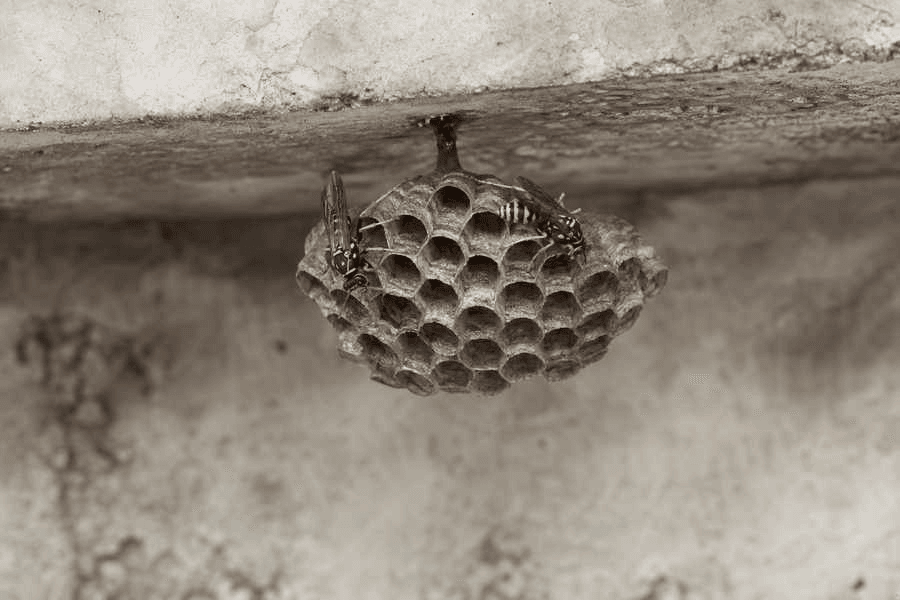
If a nest is outside your window, on your roof or in your garden, first confirm the responsible party and a safe handling arrangement.
Who handles a wasp nest in Hong Kong (compiled by Averta Pest Control): public areas (streets, pavements, parks) — call 1823 for FEHD referral; estate common areas — the management company; private premises (village-house eaves, private gardens, balconies) — the owner arranges professional removal.
Step one: who do you report it to?
- Nest in a street, footpath, park or other public place → call 1823, which refers it to FEHD.
- Nest in a housing estate's common area (podium, external wall, corridor window) → notify the management office — residential premises with a management company are its responsibility to arrange.
- Nest on your own private area (eaves of a village house, private garden, on top of an air-conditioning unit, balcony) → the owner arranges professional removal directly.
- Not sure who's responsible? → take a photo and report it to the management office first; if they say it's not theirs to handle, then arrange a pest control company yourself.
Why not remove it yourself?
Three reasons — this is our own safety advice, not a substitute for professional handling:
- Swarm defence — a disturbed nest can empty out and attack as a group. Poking it with a bamboo pole, using fire, or spraying insecticide at it through a window are all effectively declarations of war — and you have no protective gear.
- Height risk — most nests are under eaves, in trees, or high on an external wall. Dodging wasps while standing on a ladder is a double hazard.
- Removing the nest isn't the whole job — leave returning worker wasps and whatever made the spot attractive for nesting unaddressed, and a new nest often goes up in the same place quickly.
If you feel unwell after a sting or develop a severe reaction, seek medical advice promptly.
After you find a nest: basic safety principles
Nest size and activity vary by species, location and season. Once you find a nest, keep your distance, avoid attempting removal yourself, and confirm who is responsible for arranging safe handling.
Professional removal process and quote factors
Professional removal generally involves: an on-site assessment (wasp type, nest location, height, evacuation area) → timing the job (usually after dusk once the colony has returned to the nest) → applying treatment or relocating the nest in full protective gear → clean-up and advice on preventing a rebuild. Pricing mainly depends on height and accessibility (low eaves at ground level versus scaffolding or rope access), nest size, and location sensitivity (school or restaurant frontage, for example). Averta quotes wasp removal after seeing the site — a WhatsApp photo taken from a safe distance is usually enough for us to give you a ballpark; an on-site inspection is HK$350, fully credited when you book.
Before and after removal: what residents should do
Professional removal isn't a one-button job on our side alone — a bit of resident cooperation makes the whole thing faster and safer:
- Before: close windows near the nest, keep pets and children indoors, and clear clutter from the wasps' flight-path area (a balcony or corridor, for example) so the technician has clean access.
- Treatment is usually scheduled after dusk: avoid bright lights at windows near the nest during the job — light draws disturbed wasps toward it.
- After: keep nearby windows closed for a few hours, and don't wash down or touch the treated spot — let the treatment do its work.
- Seeing a few stray wasps around the old nest site for several days is normal (returning workers that were out foraging); they typically disperse within days. If it persists beyond a week, get back to us for a follow-up.
What to pin down before accepting any quote
- Does the quote include access equipment? Ground-reachable versus scaffolding or rope access can change the price a lot — get it in writing.
- If the nest rebuilds in the same spot, or large numbers of wasps are still gathering days later, is a follow-up covered and at what cost? Get the answer on the quote, not just verbally.
- Timing and keep-clear arrangements: when the team comes (usually after dusk), whether anyone needs to stay clear, and how soon you can use the balcony or window area normally again.
None of this is being difficult — a legitimate pest control company can answer all three readily. Send us a photo over WhatsApp and we'll cover these details in the quote up front.