The short answer
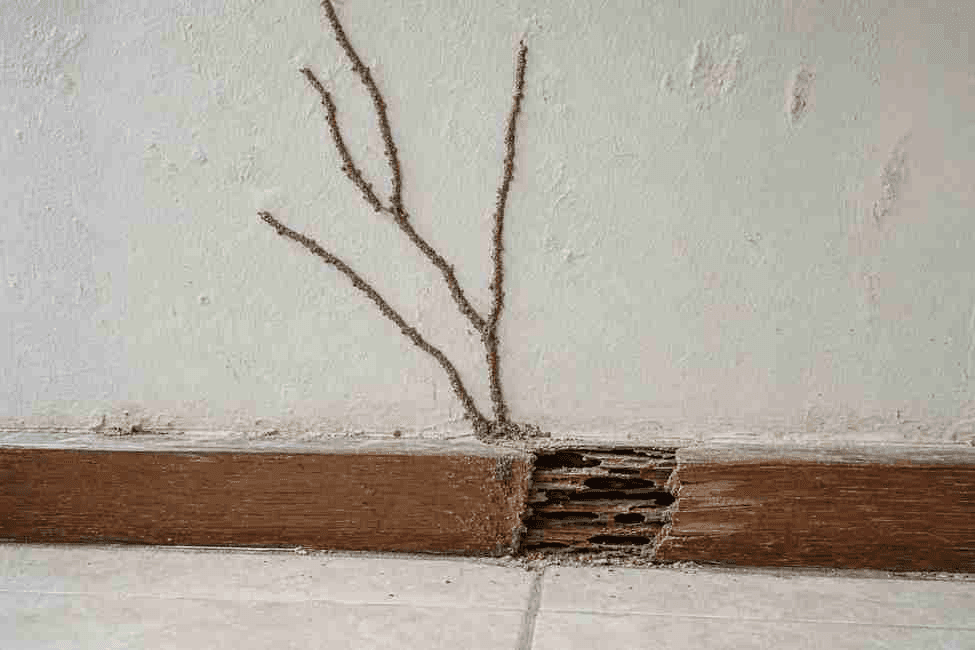
The five most common signs of termites at home: ① earth-coloured mud tubes along skirting boards or the ceiling line ② a hollow sound when you tap wood ③ fine wood-coloured powder (frass) at door and window frames ④ a scatter of discarded, translucent wings on windowsills or the floor ⑤ bubbling or warping on the surface of wooden floors or furniture. In Hong Kong, flying termites (termite swarmers) tend to come indoors most often between April and July, typically on humid, close evenings before rain.
Seeing swarmers doesn't automatically mean your flat already has termites, but it does mean there's a mature colony nearby — worth checking out.
What are flying termites, and how do they relate to a termite problem?
Flying termites — 大水蟻 in Cantonese, sometimes called termite swarmers — are the winged reproductive caste of a termite colony, not a separate species. Each year, during swarming season, a mature colony releases large numbers of winged reproductives to mate and disperse. They're drawn to light and fly indoors, shed their wings once they land, and a successfully paired couple then looks for a damp, dark spot — the underside of a wooden door frame, a kitchen or bathroom timber cabinet, a false ceiling void — to try to found a new colony.
So it's worth separating two different situations:
- Swarmers flying into your flat means there's a mature colony nearby and your flat is a "candidate site". Handle it properly that same evening and the risk stays limited.
- Mud tubes or frass found inside your flat means a colony has quite possibly already established itself in or around the structure, and a professional inspection is warranted.
The 5 signs, one by one
| Sign | How to check | What it means |
|---|---|---|
| ① Mud tubes | Look along skirting boards, ceiling lines and pipe runs for thin earth-coloured tubes | Termites' "transport tunnels" — the clearest evidence of all |
| ② Hollow wood | Tap door frames and skirting boards with the handle of a spoon and listen for a hollow sound | The interior has already been eaten out even though the surface looks intact |
| ③ Frass / wood powder | Fine powder collecting at the base of door and window frames | Active feeding under way |
| ④ Discarded wings | A cluster of clear wings on a windowsill, under a light, or on the floor | Reproductives have come indoors and shed their wings after mating |
| ⑤ Bubbling wood surface | Paint bubbling or a wavy, warped look on wooden floors or furniture | Feeding has reached near the surface — usually a mid-to-late-stage sign |
Flying termites came in tonight — what should you do?
- Turn off lights, close windows — swarmers are drawn to light, so cutting the light source cuts the reason they're coming in. Leaving a single dim light on further from the window to draw them away works even better.
- Put a bowl of water under the light — swarmers dive at the light and drop into the water, simple and effective.
- Clear away the bodies and wings — while you're at it, check for any pairs that have already shed their wings and are moving together — those are the ones that matter.
- Don't blanket-spray insecticide everywhere — our professional recommendation: indiscriminate spraying scatters reproductives that haven't settled yet, pushing them to hide and disperse, which can actually increase the chance of them establishing somewhere in your flat. And a colony inside a wall is never something a surface spray reaches anyway.
- Run the 5-sign check the next day (see table above), paying particular attention to the base of kitchen and bathroom timber cabinets and the foot of door frames.
When should you get a professional inspection?
If you see any of signs ①②③, or flying termites keep coming in over several consecutive evenings, it's worth arranging a professional inspection. Termite treatment isn't like general pest control — the goal isn't killing what you can see, it's tracing the mud tubes back to the colony, treating it thoroughly with injection or baiting, and following up to confirm it's cleared. As a market reference, termite treatment in Hong Kong typically runs from around HK$3,000 to HK$15,000 (compiled from publicly available quotes as of July 2026, for reference only), depending on the scope and method involved. Averta's termite service starts from HK$3,380, with a HK$350 inspection fee fully credited when you book.
What does a professional termite inspection actually look like?
We covered why quotes vary so widely in our pricing guide. This is about something else: whatever the price bracket, here's what you should actually see a genuine termite specialist do during an inspection.
- Tracing mud tubes, not just eyeballing — following tube runs along skirting, door frames and pipe routes to judge roughly where the colony sits; a quote made without this step has nothing behind it.
- Naming the method and the reason — baiting system or chemical barrier, and why your flat suits one over the other; be wary of anyone who can't explain the difference.
- Raising follow-up visits unprompted — termite treatment isn't a one-visit job; a proper proposal includes a re-inspection schedule and warranty terms.
- An itemised quote — inspection, treatment, follow-up and warranty listed separately; a single lump figure with no breakdown is impossible to compare.
These checks aren't termite-specific — they apply to choosing any pest control company. For the full six-point checklist, see our guide to choosing a pest control company.